


















Introduction
This post covers the difference between a warehouse control tower and a warehouse management system (WMS). It explains what each one does and why operations leaders often confuse the two. By the end, you’ll know how a warehouse control tower adds real-time visibility on top of the WMS you already run.
Table of Contents
What a WMS Does
A warehouse management system runs the daily work inside your four walls. It tells a picker which bin to go to next, confirms a put-away, and closes out an order for shipping. A WMS is the system of record for inventory movement and labor transactions as they happen.
Most WMS platforms handle receiving, put-away, picking, packing, and shipping well. Some add slotting logic, wave planning, or basic labor standards. In most environments, a WMS does not do one thing well: show you what is happening right now across shifts, sites, or systems outside its own four walls. It records history. Harmonizing that history with your time and attendance system, your robotics, or the WMS at a different site is not part of the job.
That gap reflects a scope limit. A WMS executes transactions inside its own four walls. Harmonizing data across sites and systems is a different job, and it is the job a warehouse control tower does.
What a Warehouse Control Tower Does
Gartner analysts have pointed out that this category of platform gets described loosely across the supply chain industry. There is no single standard definition. That looseness is part of why confusion sets in when a vendor pitch places the phrase next to your WMS.
Inside the four walls, the definition is more specific. A warehouse control tower connects to the systems already running in your operation: your WMS, your time and attendance system, and your robotics. It pulls their data into one connected view. It does not replace what those systems do. Instead, it sits above them, turns scattered transactions into a single picture of labor, inventory data, and process performance, and keeps that picture current through the shift.
A WMS tells you what happened at a station. A warehouse control tower tells you what is happening across the operation right now, and what that means for the next decision a supervisor or planner needs to make.
Warehouse Control Tower vs WMS: The Key Differences
The confusion usually comes down to four points:
- Scope. A WMS manages execution inside one facility. The warehouse control tower layer above it connects data across every facility running that WMS, or a mix of different WMS platforms.
- Data. A WMS records what happened, transaction by transaction. A warehouse control tower folds that record together with labor, time and attendance, and automation data into one live feed.
- Timing. Most WMS reporting is built for after-the-fact review. A warehouse control tower surfaces what is happening during the shift, while there is still time to act on it.
- Intelligence. A WMS tells you the state of an order or a bin. On top of that, a warehouse control tower adds context: how a shift is trending, where labor is misallocated, and which site in a network needs attention first.
None of this makes the WMS less important. It’s still vital to the operation. The warehouse control tower is just an added layer that shows what is happening across the whole operation.

Why They Are Complementary, Not Competing
A warehouse control tower and a WMS do different jobs within the same operation. The WMS executes. The warehouse control tower observes, harmonizes, and surfaces what the WMS alone cannot show. That includes a connected view of labor, inventory data, and automation across the parts of the operation that sit outside any single system’s reach.
Framed that way, a warehouse control tower protects the investment your team already made in its WMS. It extends that value by giving the WMS’s data somewhere useful to go. That means pairing it with data from time and attendance, robotics, and any other system running in the facility.
For IT and systems leaders, that distinction matters for a different reason. A new visibility layer does not mean a new systems integration project that competes for the same resources already committed to the WMS. It means a connection built to run alongside what IT already maintains.
No Rip-and-Replace: Sitting on Top of Any WMS
Adopting a warehouse control tower does not require replacing the WMS already running your operation. That layer is built to connect to the systems already in place. It works whatever WMS a site runs. The same is true whether that WMS is old or new, or different from the one running at another site.
This matters most for multi-site operations. Many networks run different WMS platforms at different sites, often for reasons tied to acquisitions, regional requirements, or legacy contracts. A warehouse control tower does not ask a network to standardize on one WMS before it can help. It connects to what is already there and harmonizes the output.
Harmonizing Data Across Multiple Systems and Sites
Most operations do not run a single system. A 2026 survey of warehouse and distribution professionals by Modern Materials Handling found that roughly half of respondents run a WMS or inventory management system. Nearly a third run separate supply chain planning software. Many also run distinct labor management, transportation, and warehouse execution systems side by side, and respondents named compatibility with existing systems among their top implementation challenges.
That is the reality a warehouse control tower is built for. Rather than asking a network to consolidate onto one system, it pulls data from each one and resolves it into a single, current view. A supervisor working a shift at one site sees the same kind of picture as a regional leader comparing performance across five sites running five different WMS platforms.
Multi-site comparison is where this matters most. Two sites running different systems rarely define the same metric the same way. A warehouse control tower normalizes that difference, so a regional leader compares like with like instead of translating five sets of numbers by hand.
That is the scenario a Supply Chain Director or Head of Logistics runs into most often. A network builds up over years, through acquisitions and regional rollouts. Every site ends up running its own WMS, with its own definitions and its own spreadsheet for turning local numbers into something a leadership team can compare. A warehouse control tower removes that translation step by harmonizing the data before anyone has to look at it.
How Rebus Works as a Warehouse Control Tower
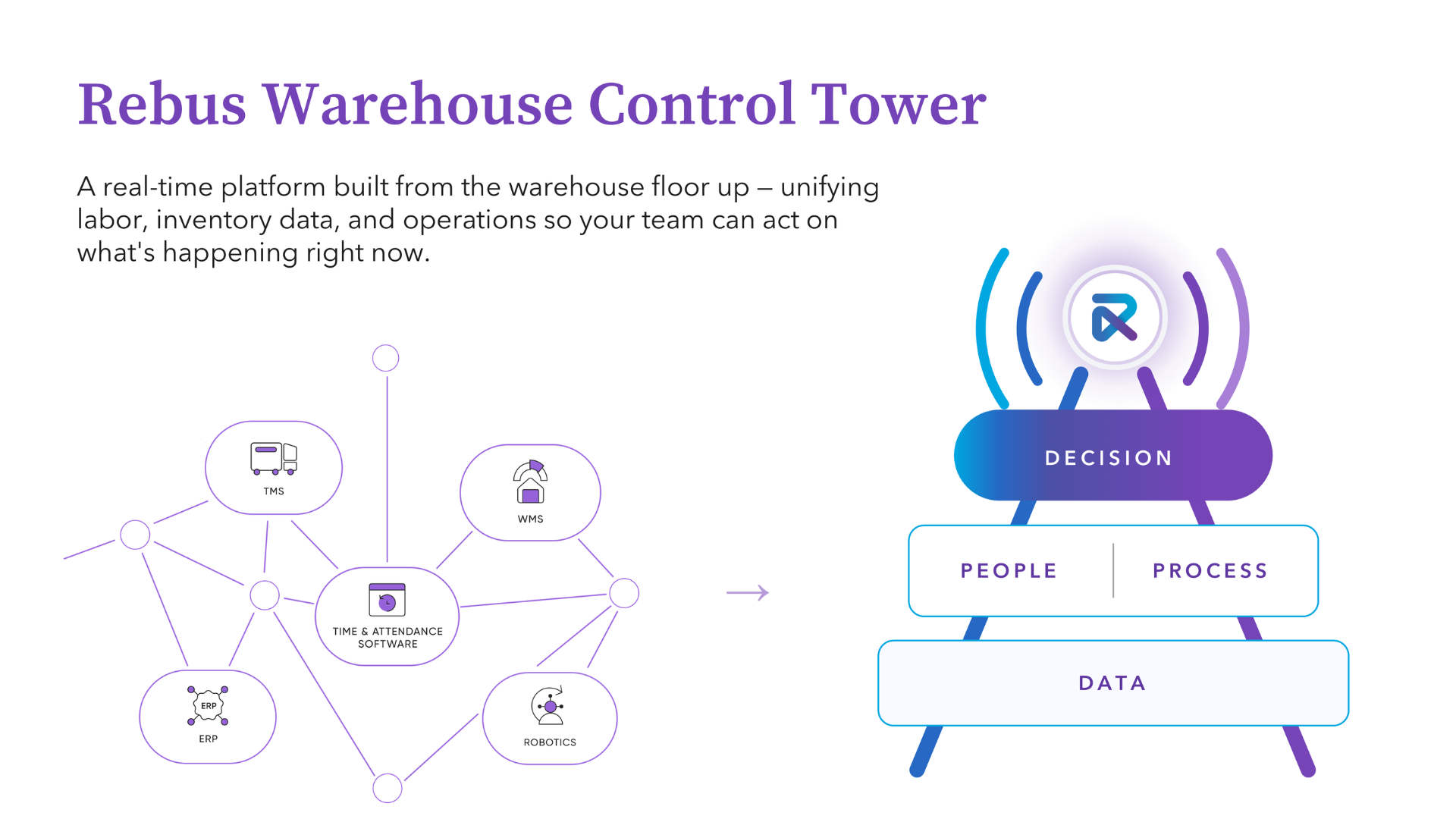
Rebus is a warehouse control tower built from the warehouse floor up. It connects to the WMS already running at each of your sites, along with your time and attendance system, your robotics, and other operational systems. That connection runs through a direct database link, an API, or a file feed, and it never touches your production environment.
Once connected, Rebus harmonizes that data into one real-time view across labor, inventory data, and process performance, whether you are looking at one site or comparing performance across a hundred.
On the labor side, Rebus gives supervisors and operations leaders a live view of what the workforce is doing across every shift and every site.
On the operations side, Warehouse Analytics extends that same visibility to orders, processes, and automation, connected to the same workforce data in one platform.
Your WMS keeps doing what it does well. Rebus gives you the layer above it that your WMS lacks.
And it doesn’t require a network to standardize on a single WMS first. A plant running a fifteen-year-old WMS on an old site and a newer site on a different platform both plug into the same Rebus view on day one.
Rebus Is the Warehouse Control Tower That Works With the WMS You Already Run
Traditional control towers show you what happened. Rebus shows you what’s happening in real time and what to do about it.
See what a warehouse control tower looks like running on top of your own systems. Request a Rebus demo and bring your WMS, your sites, and your questions.
Frequently Asked Questions About the Difference Between Warehouse Control Towers and WMS
- Is a warehouse control tower the same as a WMS?
No. A WMS executes transactions inside one facility. A warehouse control tower connects to your WMS and other systems. Together, they give you a live, harmonized view across labor, inventory data, and process performance.
- Does Rebus replace my WMS?
No. Rebus connects to the WMS you already run and adds a real-time visibility layer on top of it. Your WMS keeps handling execution; Rebus harmonizes the data.
- What does a warehouse control tower add on top of a WMS?
A warehouse control tower adds real-time visibility across labor, inventory data, and process performance. It harmonizes that picture from your WMS and other systems into one connected view.
- Can a warehouse control tower connect to more than one WMS?
Yes. A warehouse control tower is built to connect to multiple WMS platforms at once. That is what makes multi-site comparison possible across a network running different systems.
- How does a warehouse control tower help multi-site operations?
It normalizes data from different WMS platforms into one standard view. Leaders can then compare performance across sites without manually reconciling different metric definitions.
- Does a warehouse control tower work inside the four walls or across the supply chain?
As covered here, a warehouse control tower operates inside the four walls. It covers labor, inventory data, and process performance at the site and network level.
- How quickly can a warehouse control tower connect to existing systems?
Rebus connects to existing systems, including WMS, time and attendance, and robotics. There’s no long replacement project, often just a direct database link or API.
- What does “real time” mean for a warehouse control tower?
For Rebus, real time means data updates across dashboards and alerts in under five minutes. That means decisions reflect what’s happening now, not yesterday’s report.
- How does Rebus work as a warehouse control tower on top of my WMS?
Rebus connects to your WMS and other systems and harmonizes their data. Supervisors and leaders get a live view of labor and operations, with no system replacement required.