















Introduction
This post answers a question many operations leaders have never had to spell out: what is a labor standard? It explains the real methods used to set one: engineered, data-driven, and informal. Then it walks through how each one is actually calculated. That way, you can walk into your next standards conversation with a grounded, specific answer instead of a guess.
Table des matières
The Number on the Dashboard Nobody Can Explain
Your dashboard shows 94% of standard for the receiving team this week, and someone is about to ask what that number is measured against. You know the shift ran well. You’re less sure where “standard” came from in the first place. You think maybe it was set by a consultant years ago. Or maybe the WMS carried it over from implementation. But nobody quite remembers for sure.
This happens more often than most people realize. Leaders use the term “labor standard” constantly: in dashboards, in budget conversations, in a vendor’s pitch. But too often, nobody has a clear sense of what it measures or where it comes from. Maybe you’re being asked to fund a formal standards project. Maybe you’re just trying to understand the number already on your dashboard. Either way, the first step is to answer: what a labor standard actually is, the real options for building one, and how each one gets calculated.
What Is a Labor Standard in a Warehouse?
Put simply, a labor standard is the expected amount of time, or expected output, for a specific warehouse task. It’s performed under defined conditions, by a worker operating at a normal, sustainable pace. Picking 60 units per hour on a defined pick path is a labor standard. So is palletizing 40 cartons per hour at a specific case weight and pallet height. Each describes what the task actually takes, not what someone wishes it would take.
That distinction matters. A goal is aspirational: leadership wants throughput up, so it sets a target. A labor standard reflects a calculation. It comes from how the work happens under real conditions, at a pace a worker can sustain shift after shift. The two can align, but they start from different places. Confusing them is where a lot of “performance vs. standard” conversations go sideways.
This is also the number behind almost every productivity metric a supervisor sees. “94% of standard” only means something if someone set the standard accurately in the first place. A standard built on guesswork, or inherited from a system nobody remembers configuring, produces a performance number that looks precise yet tells you very little.
Types of Labor Standards: Engineered, Data-Driven, and Informal
There are three real paths to a labor standard:
Engineered standards come from direct observation. An industrial engineer or specialized consulting firm runs a time-and-motion study, or applies a predetermined time system. Either approach breaks a task into its individual, repeatable motions and builds a standard from them. The Institute of Industrial and Systems Engineers, the professional body for industrial engineering, lists “engineered standard” as a formal synonym for “standard time.” It defines that as a unit time value for a task, set by qualified people applying recognized work-measurement techniques. This is the most heavily audited of the three methods. It’s also the one most people picture first when they hear the phrase “labor standard.”
Data-driven standards come from a different direction: statistical analysis, typically regression, run against an operation’s own historical WMS, time-and-attendance, and task-level data. No separate observation study is needed. That analysis derives the expected time for a task from how it has actually performed, at scale, across real shifts.
Informal standards are the honest third category. Many operations run on a supervisor’s rule of thumb. Others inherit a number in a spreadsheet from someone who left years ago, or a default value a vendor shipped with the system. This is common. It’s probably closer to where a large share of leaders are starting from than either formal method above.
However a standard gets built, what matters is the same across all three. It needs to be specific to the task, grounded in real observation or real data, and kept current as conditions change. The method is a means to that end, not the end itself.
How Are Labor Standards Calculated?
The “how” differs sharply by method, even though the goal doesn’t.
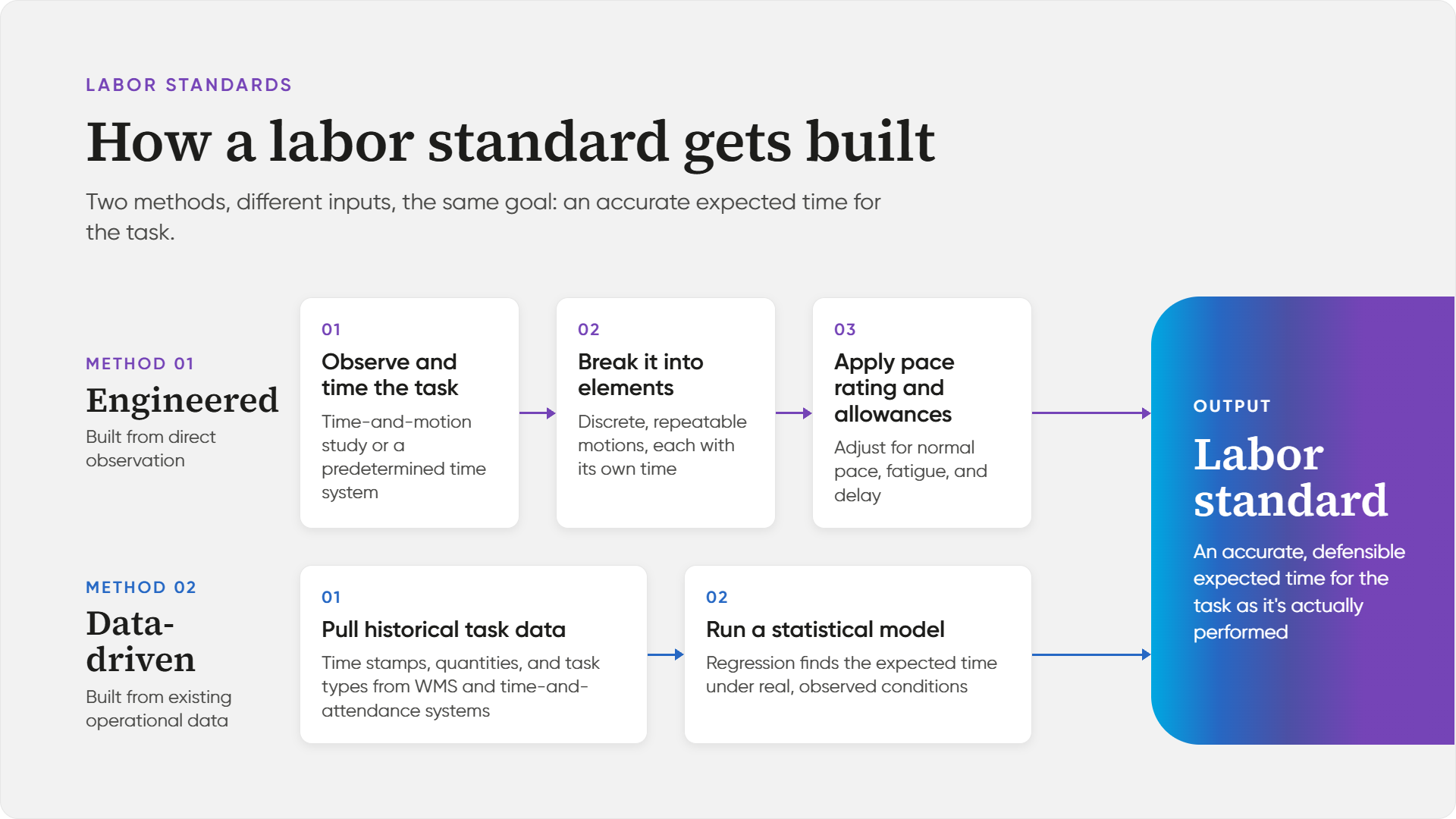
For an engineered standard, an analyst observes or times the task directly, or references a predetermined time system covering those motions. The analyst breaks the task into elemental motions, like reach, grasp, carry, and place. Next comes a performance rating, adjusting for whether the observed pace ran faster or slower than normal and sustainable. Then the analyst adds allowances for personal needs, fatigue, and unavoidable delay. What remains after those adjustments is the standard time for the task.
A data-driven standard starts from a different place: historical task-level data already sitting in your own systems. You pull time stamps, quantities, task types, and conditions from your WMS, time-and-attendance system, and other operational tools. A statistical model then identifies the expected time for the task under its actual, observed conditions, with no separate observation study required. This only works when your systems are accurately capturing time and task data in the first place.
Both methods can produce either a single-determinant or a multi-determinant standard. That choice isn’t tied to which calculation method you use. A single-determinant standard sets one expected time regardless of task variation. A multi-determinant standard accounts for variables, like travel distance, case weight, or pallet height, that change how long the task should reasonably take.
Either way, the inputs differ and the goal doesn’t. A stopwatch and direct observation drive one path. Existing operational data drives the other. Both aim for the same thing: an accurate, defensible expected time for the task, as your team actually performs it.
Is a Labor Standard the Same as a KPI?
No. A labor standard is a baseline: the expected time for one specific task. A KPI, like units per hour, on-time ship rate, or labor cost per unit, is usually an aggregate performance measure. It’s often calculated against a standard, rather than standing in for one. Units per hour tells you how fast a team is moving. It doesn’t tell you whether that pace is good until you compare it to a standard.
The two connect directly. A KPI is only as meaningful as the standard behind it. A KPI built on a bad or outdated standard looks precise on a dashboard and tells you very little about what actually happened on the floor.
This distinction gets its own full treatment later in this series, including where the two diverge and where teams most often confuse them. For now, the short version is enough to keep moving: a standard is the yardstick, and a KPI is the measurement taken against it.
How to Set Labor Standards in a Warehouse
Start with task selection. Not every task needs a formal standard on day one. Prioritize your highest-volume or highest-variability tasks first, since that’s where an inaccurate standard costs you the most in misallocated labor and distorted reporting.
Next, take stock of what data or observation already exists. Clean, historical task-level data already captured in your WMS and time-and-attendance systems supports a faster, lower-cost data-driven path. Highly specialized or infrequent tasks, where that kind of data doesn’t exist yet, may still call for direct observation before you can set a standard with confidence.
A hybrid approach is common, and reasonable. Many operations build engineered standards for a handful of complex, high-stakes tasks. Then they build data-driven standards for the high-volume, repeatable work that makes up most of the floor. Neither method has to carry the whole operation on its own, and most mature programs end up running both side by side.
There’s one more point worth flagging early: a standard set once and never revisited gets less accurate as processes, layouts, and product mix change. A standard that was right two years ago may already be wrong today, but nobody notices until the performance numbers stop making sense. How often to revisit a standard is worth its own conversation later in this series.
The throughline across all of this: the method matters less than the result. Is the standard specific to the task? Grounded in real data or observation? Kept current? Get those three things right, and fit for your operation is the only decision left.

How Rebus Works with Labor Standards
If you’re still working through which method fits your operation, that’s okay. Choosing how to build a standard deserves more thought than a vendor’s default answer. There’s no prize for picking the fastest path if it produces a standard nobody trusts.
Rebus works with engineered standards or without them, or a combination of both. In practice, that means Rebus measures performance against whichever standard your operation already uses: engineered, data-driven, or a mix of the two. Or it helps surface a data-driven standard from the operational data already flowing through your WMS, time-and-attendance, and other systems.
If you want to see what that looks like against your own operation’s data, take a look at Rebus Labor Management System. There’s no need to have the method question fully settled before that conversation starts.
Frequently Asked Questions About Warehouse Labor Standards
- What is a labor standard?
A labor standard is the expected time or output for a specific warehouse task, performed under defined conditions, at a normal, sustainable pace. It’s the baseline behind every “performance vs. standard” metric on a dashboard.
- What are the types of labor standards?
The three common types are engineered standards (built from direct observation or time studies), data-driven standards (built from statistical analysis of existing data), and informal standards (unformalized rules of thumb).
- What is an engineered labor standard?
An engineered labor standard comes from direct observation, like a time-and-motion study, or a predetermined time system. It breaks a task into elemental motions and applies pace ratings and allowances.
- How are engineered labor standards developed?
An analyst observes or times the task, breaks it into elemental motions, applies a performance rating and allowances for fatigue and delay, then calculates the standard time.
- How are labor standards calculated?
Engineered standards come from direct observation and time-motion analysis. Data-driven standards come from statistical analysis of historical task data. Both aim for an accurate expected time.
- Is a labor standard the same as a KPI?
No. A labor standard is a baseline expected time for one task. A KPI, like units per hour, is a performance measure usually calculated against that standard.
- What’s the difference between single- and multi-determinant labor standards?
A single-determinant standard sets one expected time regardless of task variation. A multi-determinant standard accounts for variables, like travel distance or weight, that change the expected time.
- How do I set labor standards in my warehouse?
Start with your highest-volume or highest-variability tasks, check what data or observation already exists, and consider a hybrid: engineered for complex tasks, data-driven for repeatable ones.
- How does Rebus work with labor standards?
Rebus works with engineered standards or without them, or a combination of both. It measures performance against whichever standard you already use, or helps surface a data-driven one from existing data.

Labor Management System ROI: The Math Behind Your Fastest Payback

Warehouse Control Tower vs WMS: What’s the Difference?