















Introduction
This post covers labor standards vs KPIs: the difference between a warehouse KPI and a labor standard. Operations teams often use the two terms as if they meant the same thing. It explains what each one actually measures, how engineered and data-driven labor standards compare, and where a metric like units per hour fits into both. That way, you can build a measurement framework that uses KPIs and standards for what each is good at. No single dashboard number has to answer every question leadership asks.
Table des matières
When a Budget Meeting Asks What Your Numbers Actually Mean
You’re six slides into a quarterly ops review when the CFO stops you cold: “Your units-per-hour number looks solid, but what’s it measured against?”
You don’t have a clean answer. The number came straight from the WMS report. It’s a real rate your team actually hit last month. But nobody set a target for what that rate should be. You can’t say whether it’s objectively good or not. That gap, labor standards vs KPIs, usually stays invisible until a budget conversation, an audit, or a vendor demo forces someone to name it. Once it’s named, it’s hard to unsee. The core difference between a KPI and a labor standard is:
- A KPI tells you what happened
- A labor standard tells you what should have happened
Mix the two up, and every dashboard number becomes a vague directional report.
What a Warehouse KPI Actually Measures
(If you’re still getting oriented on what warehouse labor management covers more broadly, start there before narrowing into this distinction.)
A warehouse KPI is a measured outcome. It tells you what happened over a set period: units completed, orders shipped on time, inventory accuracy at the last count. Throughput, on-time-in-full (OTIF), inventory accuracy, and dock-to-stock time are the ones most operations already track daily. (This blog about warehouse performance covers the full list of core metrics, if that’s what you came here for.)
What a KPI doesn’t do is tell you whether the number is good. A shift that completed 420 units has a fact attached to it, not a verdict. Was 420 strong, average, or a sign something slipped? The KPI alone can’t answer that.
That gap is wider than most operations realize. The WERC 2026 DC Measures Report tracks 36 separate operational metrics across distribution operations. A typical warehouse already has plenty of numbers on a dashboard. Having a metric and having a standard to measure it against are two different things, and a report that size makes how easy that distinction is to miss.

What a Labor Standard Actually Is (And the Two Ways to Set One)
A labor standard is an expected value for a specific task. It’s the time or output rate a worker should achieve under defined conditions. Unlike a KPI, a standard carries a built-in judgment. It’s the figure an actual result gets measured against.
Operations usually set one of two ways. An engineered standard comes from a time-and-motion study. A data-driven standard comes from a statistical baseline built from the operation’s own historical performance. Neither is the “real” one. Both produce the same kind of number: an expectation a KPI can be measured against.
(What Is a Labor Standard, and How Is It Calculated? covers both methods, plus a third informal path, in more depth, if you want the full mechanics behind each one.)
What matters here is simpler: a labor standard describes a category of measurement, not a single technique, and either way, it does the same job: giving a KPI something to compare against.
Labor Standards vs. KPIs: The Difference That Actually Matters
A KPI without a standard is a measurement with nowhere to point. A standard without a KPI is a target nobody is checking against. Put the two together and you get a third number that actually drives decisions: variance, the gap between them. Variance is what turns raw numbers into a verdict: ahead of pace, on pace, or behind, and by how much.
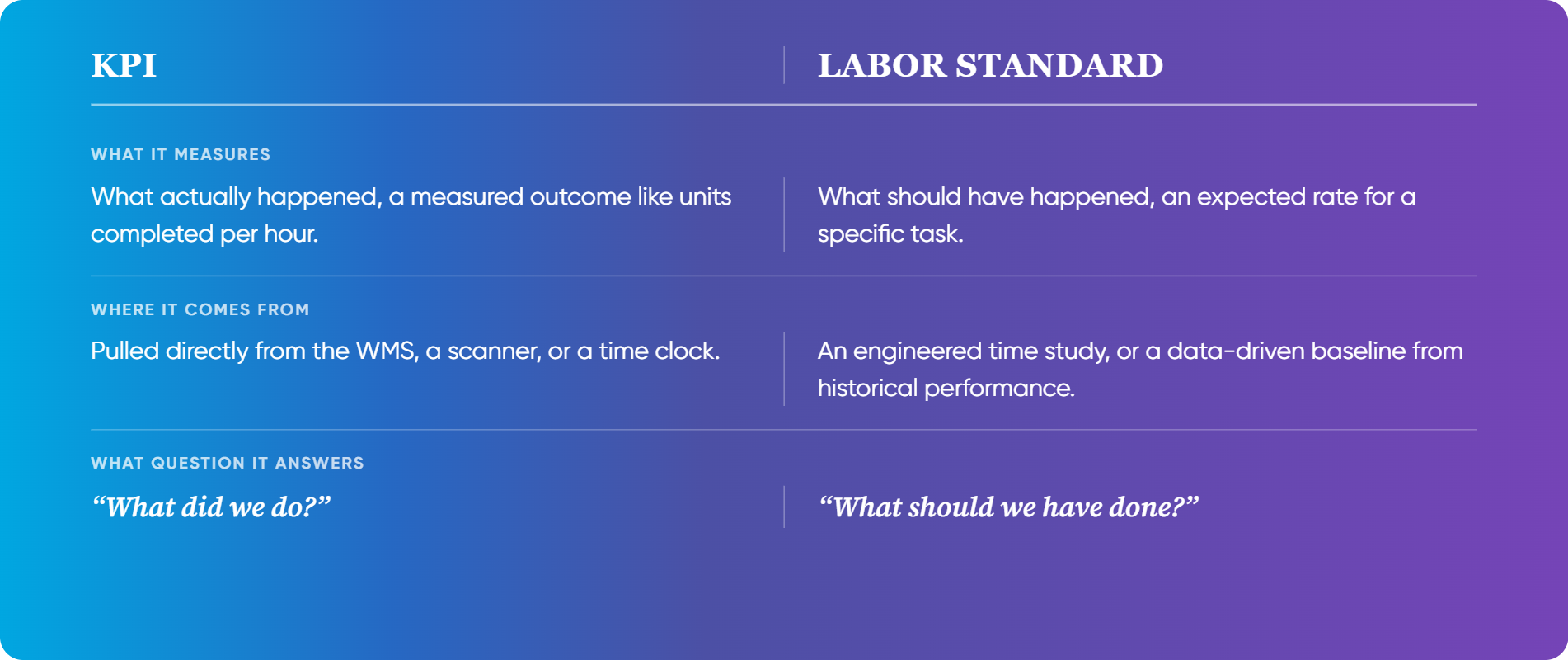
A labor standard gives a KPI something to be measured against. Once you can say that cleanly, a budget conversation about a new time study gets more specific. So does a vendor demo promising a full metrics dashboard. The question stops being “do we have good numbers?” It becomes “do our numbers have a standard attached to them?”
Units Per Hour: KPI, Standard, or Both?
Units per hour (UPH) is the metric nearly every operation already tracks. That makes it the clearest way to see this distinction in practice. UPH can be either a KPI or a labor standard, depending on how you’re using it.
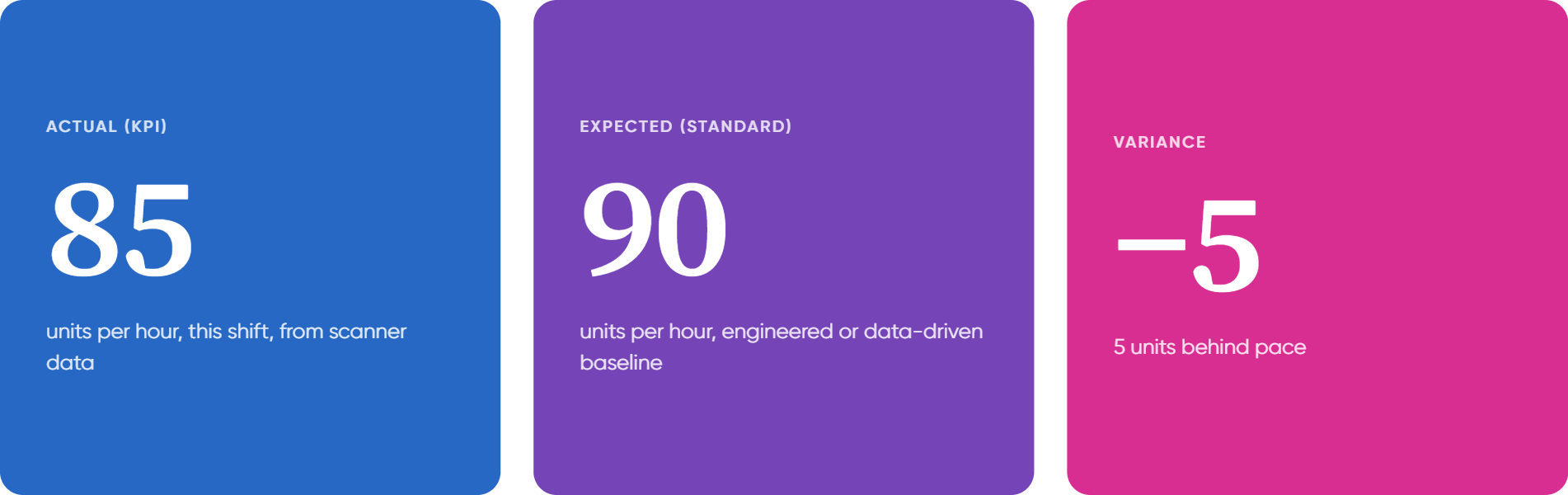
As a KPI, UPH is simple. It’s the rate a team actually achieved. A picker completed 85 units in an hour last shift. That’s a fact, pulled straight from the WMS or scanner data.
As a labor standard, UPH is a target: the rate a worker should achieve for that specific task under normal conditions. That target can come from an engineered time study. An industrial engineer measures the task and sets 90 units per hour as the expected rate. Or it can come from a data-driven baseline. The operation’s own historical data shows the team has consistently produced 88 units per hour over the last quarter, and that figure becomes the expected rate going forward.
Put the two together and you get labor variance: the gap between what a shift actually achieved and what the standard says it should have achieved. A picker running 85 units per hour against a 90-unit standard is 5 units behind. That’s a specific enough gap to tell a supervisor whether to coach, reassign, or leave the shift alone.
How to Choose the Right Warehouse KPIs for Your Operation
Turning this distinction into something you can use this week comes down to four moves.
- Start with the operating question, not the available data. Pick the KPI that answers a real question, like “are we meeting customer commitments?” (OTIF) or “is this shift running efficiently?” (UPH). Don’t just track every number a system happens to produce.
- Attach a standard to any KPI used to judge performance. A KPI that informs a coaching conversation, a bonus structure, or a staffing decision needs a labor standard behind it. A raw KPI used that way is a guess wearing a decimal point.
- Track variance when pace is the question. The KPI tells you the rate. The standard tells you the expected rate. Variance, the gap between the two, tells you whether this shift, this week, is actually on track.
- Revisit standards on a set schedule. An engineered standard set three years ago and a data-driven baseline built from last quarter can both go stale, just on different timelines. A standard that no longer reflects current conditions, staffing, or equipment produces variance numbers that mislead instead of inform.
Used this way, labor standards in performance analysis stop being an audit requirement. They start being the thing that makes a KPI dashboard trustworthy enough to act on.
Building the Business Case for Data-Driven Labor Standards
For the VP or finance leader weighing whether to fund a new round of engineered standards, the calculation usually comes down to cost and speed. That’s the cost of engineered labor standards, weighed against how long they take to deliver results. A traditional time-and-motion study is a real, credible method. It’s also a five- or six-figure investment that can take months to deliver, one task and one site at a time. For a multi-site operation, that timeline multiplies. The bigger cost shows up while you wait: every site keeps tracking KPIs its own way, so the network number is a guess. One site reports units per hour from scanner data. Another builds it from a time clock and a spreadsheet.
Neither is wrong on its own, but neither matches the other, and a regional rollup built from mismatched definitions isn’t a number leadership can act on with confidence.
This is where Rebus Labor Management & Analytics changes the data-driven labor management business case. It can set a baseline from an operation’s own historical performance or from existing engineered UPH targets. Every site gets a standard to measure against starting day one, without waiting on a new study first. Utilization, effectiveness, throughput, and UPH get defined once. They’re reported the same way at every site, which is what makes a network-level number mean something instead of just looking like one.
Engineered standards remain a legitimate, established choice. This business case just means a site no longer has to wait on a new study before it has some standard to work from.
Ready to Set a Labor Standard Your Team Can Actually Hit?
Getting labor standards and KPIs sorted out in your own vocabulary is step one. Acting on that distinction across every site in your network is the harder part, especially if half of them are still measuring UPH a different way.
Rebus Labor Management & Analytics sets a labor standard from your own operating data or your existing engineered targets. Every site gets one to measure against, without a new study holding up the rollout. See how it works for an operation like yours.
Frequently Asked Questions About the Difference Between Labor Standards and KPIs
- What is the difference between a KPI and a labor standard?
A KPI measures what actually happened, like units completed per hour. A labor standard sets what should have happened for that task, so together they show whether performance is on or off pace.
- What is a warehouse KPI?
A warehouse KPI is a measured outcome, such as throughput, order accuracy, or dock-to-stock time. It tells you what happened over a given period, without saying whether that result was good.
- What is a labor standard in warehouse operations?
A labor standard is the expected output or time for a specific task, set either through an engineered time study or a data-driven statistical baseline built from historical performance.
- Is units per hour a KPI or a labor standard?
It can be either. Tracked as a raw rate, UPH is a KPI. Set as an expected rate for a task, UPH is a labor standard. Comparing the two produces labor variance.
- What is the difference between an engineered labor standard and a data-driven labor standard?
An engineered standard comes from a time-and-motion study. A data-driven standard comes from a statistical baseline built from the operation’s own historical performance data.
- What is labor variance?
Labor variance is the gap between a KPI (actual output) and a labor standard (expected output) for the same task, expressed as ahead of, behind, or on pace.
- How do I choose the right warehouse KPIs?
Start with the operating question you need answered, then pick the KPI that answers it. Attach a labor standard to any KPI used to judge individual or team performance.
- Why do operations teams confuse KPIs and labor standards?
Both show up as numbers on the same dashboard. Many systems don’t label which is which, so a measured outcome and an expected target can look interchangeable at a glance.
- How does Rebus support both engineered and data-driven labor standards?
Rebus Labor Management & Analytics can set a baseline from an operation’s own historical data or from existing engineered UPH targets. Every team gets a standard to measure against from day one.

Labor Management Software That Works With Your WMS: 7 Questions to Ask Before Yo…

What Is a Labor Standard, and How Is It Calculated?