



















Introduction
This post covers the warehouse labor shortage and why hiring more people isn’t closing the gap. It explains the demographic and cost factors behind the shortage, how supervisor productivity fits into the picture, and why labor optimization is the more durable path, so you can bring a sharper frame to the staffing conversation with leadership.
Table des matières
Why the Warehouse Hiring Treadmill Keeps Spinning
Post the role. Screen the candidates. Onboard the new hire. Lose them within the year. Post the role again.
If that cycle sounds familiar, you’re not imagining it, and you’re not doing it wrong. You’ve been running the same playbook for two or three years. The numbers still haven’t turned. Leadership calls it an execution problem: hire faster, screen better, close the gap. Your recruiting team calls it a market problem, pointing to thin candidate pools and wage competition from other industries. Both frames assume the fix is more hiring, done better.
Neither frame explains why the gap keeps reopening no matter how well you execute.
The pattern isn’t a hiring failure. It’s a structural mismatch between how fast your operation loses workers and how fast the labor market can replace them. Structural problems don’t respond to execution fixes. You can post more jobs, pay signing bonuses, and speed up onboarding, and the treadmill keeps spinning at the same pace regardless. Fixing that requires a different diagnosis than the one most operations are working from.
The Real Cost of Warehouse Employee Turnover
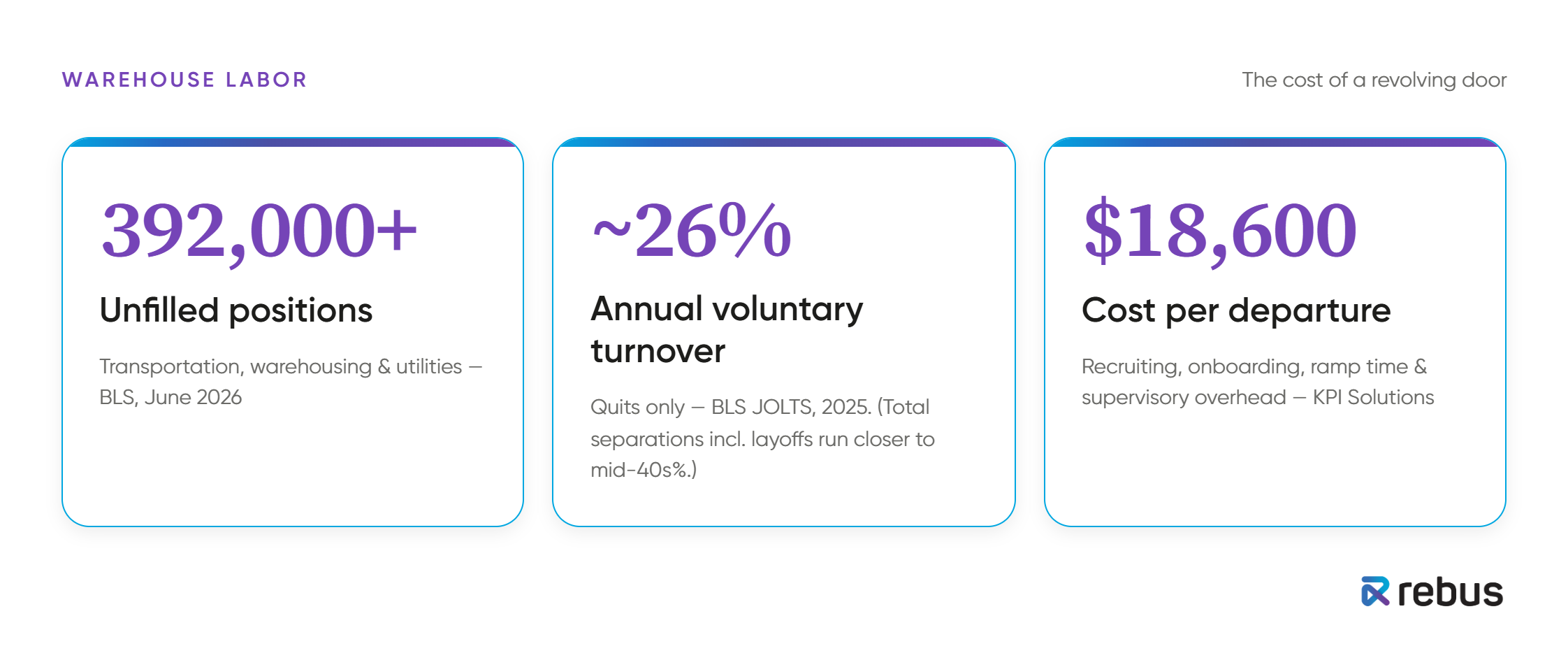
Start with the scale. The Bureau of Labor Statistics counted over 392,000 unfilled positions across transportation, warehousing, and utilities as of June 2026. That’s a combined supersector figure, not a warehouse-only count. Even so, it puts the staffing gap in concrete terms: hundreds of thousands of roles sitting open at any given time, in an economy that keeps producing warehouse work regardless.
Turnover compounds the problem. Voluntary turnover (workers choosing to leave) ran approximately 26% in this sector in 2025, according to BLS data. That figure covers quits only. Include layoffs and other involuntary departures, and the number climbs into the mid-40s%.
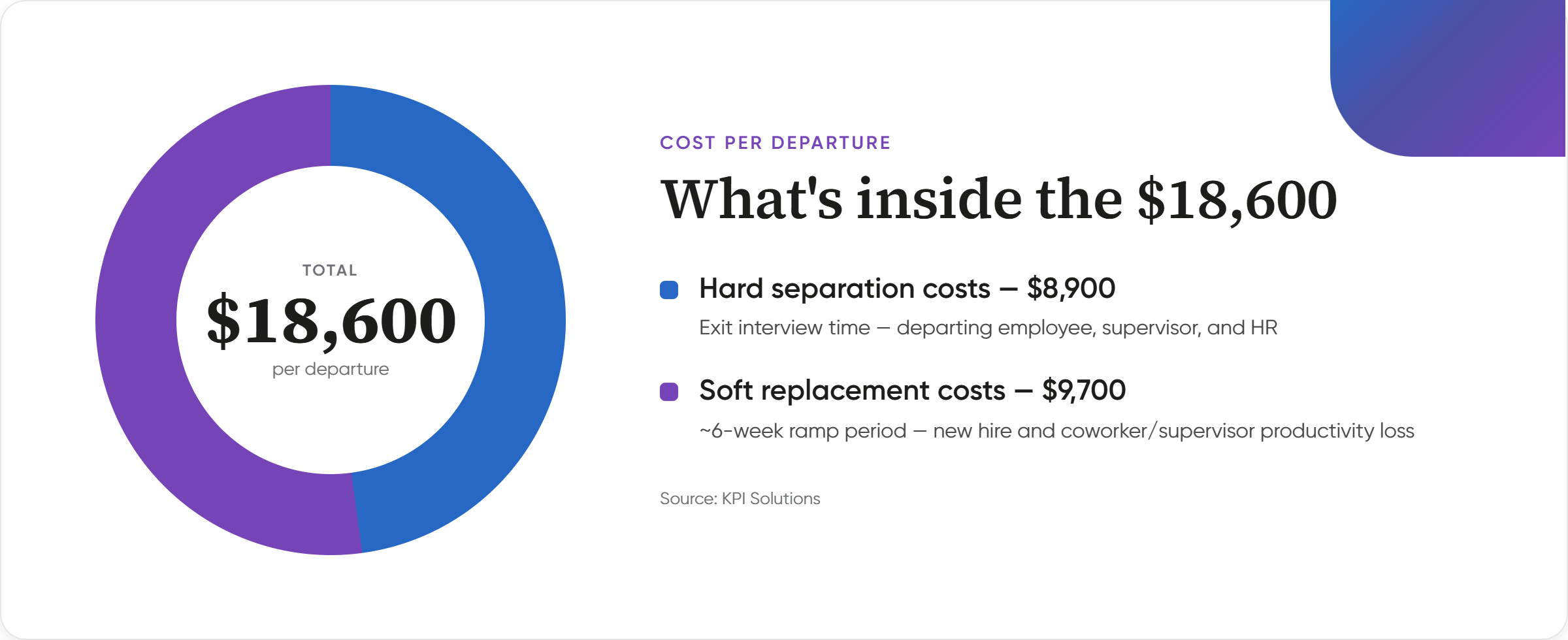
Now attach a price to it. KPI Solutions puts the average cost per warehouse departure at $18,600. That breaks down into roughly $8,900 in hard separation costs (exit interview time across the departing employee, their supervisor, and HR) and about $9,700 in soft replacement costs (the six-week ramp period during which the new hire and their coworkers run below full productivity).
Layer in ramp time and the true cost runs higher still. Sources vary, but most studies show new hires performing at an average of 50% productivity over their first several months on the floor. On a $10 million labor spend, that ramp gap alone adds up to real, recurring lost output. That’s on top of the direct cost of the departure itself.
The Structural Limits on Warehouse Workforce Growth
The reason the pipeline isn’t recovering has less to do with recruiting execution and more to do with demographics. The warehouse labor pool is aging out faster than it’s being replaced. Workers entering the labor market today have more options than the generation before them. Many are choosing roles that ask less of their bodies and offer more schedule flexibility.
Retail, last-mile logistics, and gig-economy work now compete directly for the same candidates, often at comparable pay, without the physical demands of a warehouse floor. On current terms, warehouse operations aren’t winning that comparison. No amount of recruiting spend changes the terms of the comparison itself.
This distinction matters because it changes what kind of problem you’re solving. A cyclical labor shortage eases when the economy shifts and candidates return to the market. A structural shortage doesn’t behave that way. It’s directional: the demographic and preference shifts driving it aren’t tied to the business cycle, and they aren’t reversing on their own.
Say headcount growth really is structurally constrained, and the data suggests it is. The workforce you can build a durable plan around is the one you already have, not the one you’re waiting to hire. That reframes the staffing conversation. The lever worth pulling is what your current team produces per shift, not how many people you can add to the roster. That shift is uncomfortable for operations that have spent years treating headcount as the primary lever, but it’s also the more accurate one.

How Warehouse Supervisor Visibility Changes the Productivity Equation
There’s a second lever in this picture that most shortage conversations skip entirely: the supervisor.
A single warehouse supervisor typically oversees 20 to 40 associates during a shift. Without real-time productivity data, that supervisor is coaching from memory and gut feel. Problems surface in the end-of-shift report instead of the moment they start. By the time a slowdown shows up in a summary, the shift that could have fixed it is already over.
Give that same supervisor real-time visibility into how each associate and activity is performing, and the coaching shifts from reactive to active. Warehouses that give supervisors this kind of intraday visibility see productivity improvements in the range of 20% to 40%. That gain doesn’t come from replacing supervisors with software. It comes from giving the supervisors already on the floor the data to act on during the shift rather than after it.
That’s a meaningful lever sitting inside a workforce you already employ, and it’s mostly untouched. Most conversations about the labor shortage focus entirely on associate headcount. They skip the person managing that headcount minute to minute.
Want to run a better warehouse shift starting tomorrow? Download the Supervisor Playbook today.

When You Can’t Hire Your Way Out, Optimization Is the Strategy
Put the structural argument and the supervisor argument together, and the conclusion is straightforward. When headcount growth is structurally limited, labor productivity is the only lever left that you fully control. Every percentage point of productivity improvement on a $10 million labor spend recovers roughly $100,000 in output, without adding a single hire to the roster.
The tool that makes that lever measurable is a labor management system. A good one gives operations leaders visibility by associate, by shift, and by activity type, in the moment those activities are happening, not in a report the next morning.
That’s the standard a modern labor management platform like Rebus is built to hit. It’s the difference between managing yesterday’s shift and managing today’s. Rebus LMS is built around this principle. It gives operations leaders real-time visibility to act on productivity during the shift, not after it, so the workforce you already have becomes the growth lever the hiring market can’t provide.
Ready to see what productivity optimization does to your labor numbers?
The math above works at a summary level. Applied to your specific operation, headcount, and labor spend, it gets a lot more concrete. It also gets more persuasive to the leadership team that keeps asking why the hiring problem isn’t improving.
Our eBook, Labor is Your Largest Controllable Cost, walks through the full optimization business case: how to model your own turnover cost, how to quantify the productivity opportunity sitting inside your current workforce, and what a labor management system actually changes about how supervisors run a shift. You can download it for free today.
Traditional warehouse control towers show you what happened. Rebus shows you what’s happening in real time, and what to do about it. Learn more about Rebus LMS.
Frequently Asked Questions About Warehouse Labor Shortage and Workforce Retention
- What is causing the warehouse labor shortage?
The shortage is driven by demographic shifts, not a temporary economic cycle. Workers entering the labor force are choosing less physically demanding jobs, and experienced warehouse workers are retiring faster than the pipeline replaces them.
- How many warehouse positions are currently unfilled?
The Bureau of Labor Statistics counted more than 392,000 unfilled positions across transportation, warehousing, and utilities as of June 2026, per JOLTS data.
- What is the average turnover rate for warehouse workers?
Voluntary turnover, workers who quit, ran about 26% in the transportation, warehousing, and utilities sector in 2025, per BLS JOLTS data. Including layoffs, that figure climbs into the mid-40s%.
- Why is warehouse turnover so high?
Physical demands, wage competition from retail and gig-economy work, and limited schedule flexibility all push warehouse turnover higher than many comparable industries.
- How much does warehouse employee turnover cost?
KPI Solutions estimates the average cost per warehouse departure at $18,600, combining hard separation costs and soft replacement costs during the new hire’s ramp period.
- What does it cost to replace a warehouse associate?
Replacement costs include roughly $8,900 in hard separation costs and about $9,700 in soft costs tied to the new hire’s ramp-up period, according to KPI Solutions.
- Why can’t warehouses just hire more people to fix the shortage?
The shortage is structural, tied to demographics rather than a hiring cycle. Adding recruiting spend means competing for the same shrinking candidate pool other industries are also drawing from.
- How much does new hire ramp-up time cost a warehouse?
Sources vary, but most studies show new hires operating at roughly 50% productivity during their first several months, a hidden cost layered on top of direct replacement expenses.
- How does supervisor visibility affect warehouse productivity?
Warehouses that give supervisors real-time productivity data during a shift, instead of in an end-of-shift report, see productivity improvements in the range of 20% to 40%.
- What is a warehouse labor management system?
A labor management system gives operations leaders visibility into workforce productivity by associate, shift, and activity type, in real time, so supervisors can act during the shift rather than after it.
- How does Rebus help address the warehouse labor shortage?
Rebus LMS gives operations leaders real-time visibility into workforce productivity, in under 5 minutes, so the workforce you already have becomes a growth lever the hiring market can’t provide.

Warehouse Control Tower vs WMS: What’s the Difference?

Food and Beverage Warehouse Labor Management: Closing the Productivity Gap Under…